Even though the Securing the NDIS for Future Generations Act has been law since the end of August, 1 October felt like the first real ouch. It was the day some of the things we've all been stressing about for so long actually became a reality and not something we needed to worry about "down the road."
The main one of these was the introduction of the two words which I think are going to be branded into our minds like reasonable and necessary has been, support determinations. Support determinations are now law, and over the next year they will cap the spending of two support categories in every NDIS plan. However, it is important to remember that nothing happens to the plan you've got at this very moment. Until 30 September 2027, support determinations are only going to affect plans when they are reassessed, and after 1 February 2027, renewed.
So let's go through it properly; what a support determination actually is, what it does to NDIS plans, when will it do when it reaches your child's plan and, what's worth doing now.
What is an NDIS support determination?
A support determination is a power that was built into the Securing the NDIS for Future Generations Reforms which gives the Minister of the NDIS power to limit how much of certain support categories you can spend. It applies to everyone whose plan has the support categories in their plan and is not a decision that is made based on the individual needs of a person and their disabilities.
Which NDIS budgets do support determinations reduce?
Two, and only two:
- Assistance with Social, Economic and Community Participation (Core): reduced by 50%. For most kids, this is the support worker hours that get them out into the community.
- Improved Daily Living Skills (Capacity Building): reduced by 10%. This is where of our kids' therapy funding lives.
The Government's stated aim is to bring average spending on community participation back to where it sat in 2023.
Is a support determination a change to reasonable and necessary?
No, and this what makes this whole thing even more confusing.
At a plan reassessment, your planner still works out what NDIS supports are reasonable and necessary for your child, using the same section 34 of the NDIS Act checklist. You can still get the full amount of community participation and Improved Daily Living funding built into your child's plan. What the support determination does is stop you from being able to spend all of it.
The printed text in terms of funding that has been built into the plan doesn't change. The determination sits over the top of it, and the Agency tells you how much you can actually use. Yes, that means your plan can show one number while you're only allowed to spend another. If that sounds like a recipe for families accidentally overspending, you are not wrong (or is that just me?).
It also means the case you build for your child's full need still matters.
What's protected from support determinations?
Everything outside those two support categories is untouched. Help with eating, drinking, dressing and toileting, household tasks, nursing care, medication, consumables, equipment, home and vehicle modifications, Specialist Disability Accommodation and support coordination all stay as they are.
Inside the two reduced categories, some groups of supports are protected.
Protected inside community participation:
- supports in employment
- high intensity supports
- intensive and complex behaviour supports
Protected inside Improved Daily Living:
- disability-related health supports (nursing)
- customised and wearable technology
- hearing services
The NDIA has also published a list of the protected support items so you can match them against your plan.
Protection follows the line item, not the purpose
Now we get into NDIS nerd territory, but, bear with with me.
The rules (that are like the law) about support determinations list the protected supports by their support item names. So "supports in employment" means the Supports in Employment line items. It does not mean any support that happens to help your young person get to work. If a support worker taking your teenager to their part-time job is funded under a standard community access line, that funding is halved. You'll see exactly that in the second example below.
The 2026 claims rule for renewed plans
If your child's current plan started before 1 October 2026 and gets renewed from February 2027, a protected support only stays protected if a payment was made for it at some point during 2026. For plan managed and agency managed families, that payment has to be under the protected line item itself. For self-managed families, any payment from that budget during 2026 counts.
In plain English: if your child has nursing in their Improved Daily Living budget, but nursing services haven't been used in 2026, the 10% could then come off the whole budget, nursing included.
This doesn't apply to plans that are new or reassessed from 1 October. For those, the Agency only looks at what was allocated when the plan was built.
What does the community participation cap look like in a real plan?
These are real NDIA plan breakdowns. I've changed the figures and details for privacy, so don't read the hourly rates as current prices.
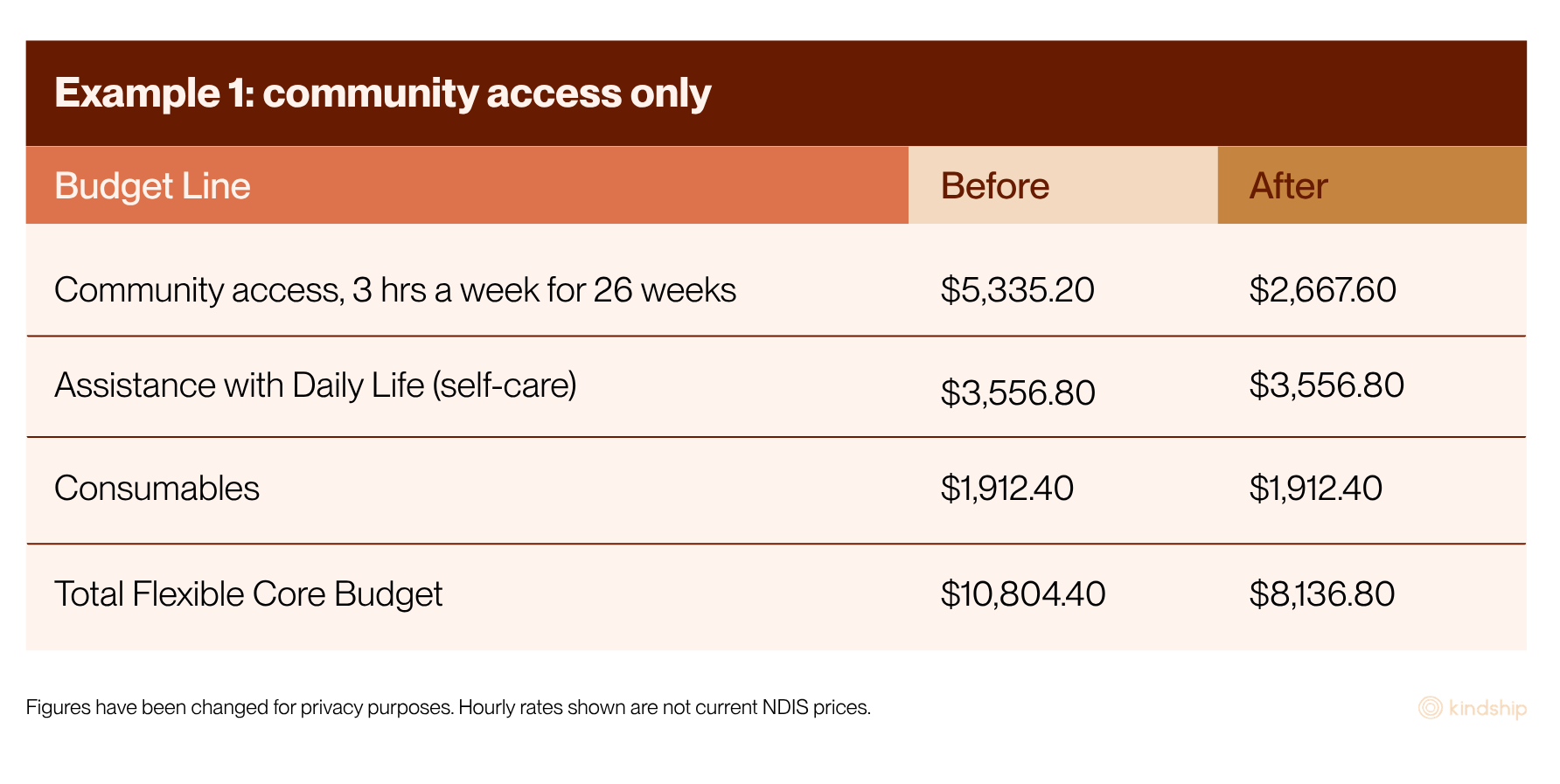
This family can now only spend $2,667.60 of their community access. In real life, three hours a week becomes an hour and a half. Everything else in their Core stays exactly as it is.
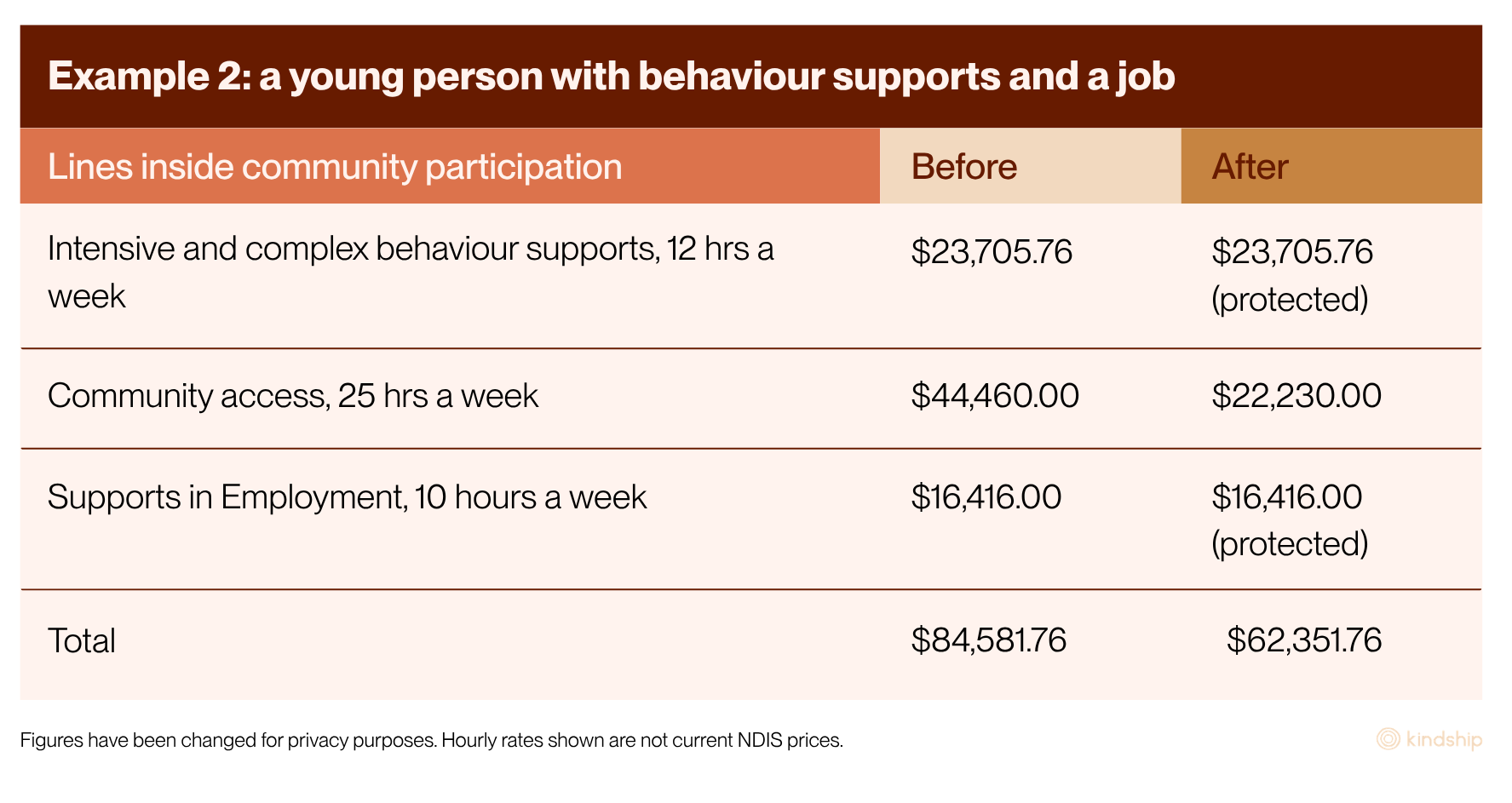
The behaviour supports and the Supports in Employment hours are both funded under their own protected line items, so they keep every dollar.
The funding to help this person engage in their employment has been funded as Supports in Employment and therefore this funding is also protected.
The 25 hours of community access is a different story. It's a standard community access line, so it's halved. That's $22,230 less for this young person to spend in helping them to access their community.
What does the Improved Daily Living cap look like?
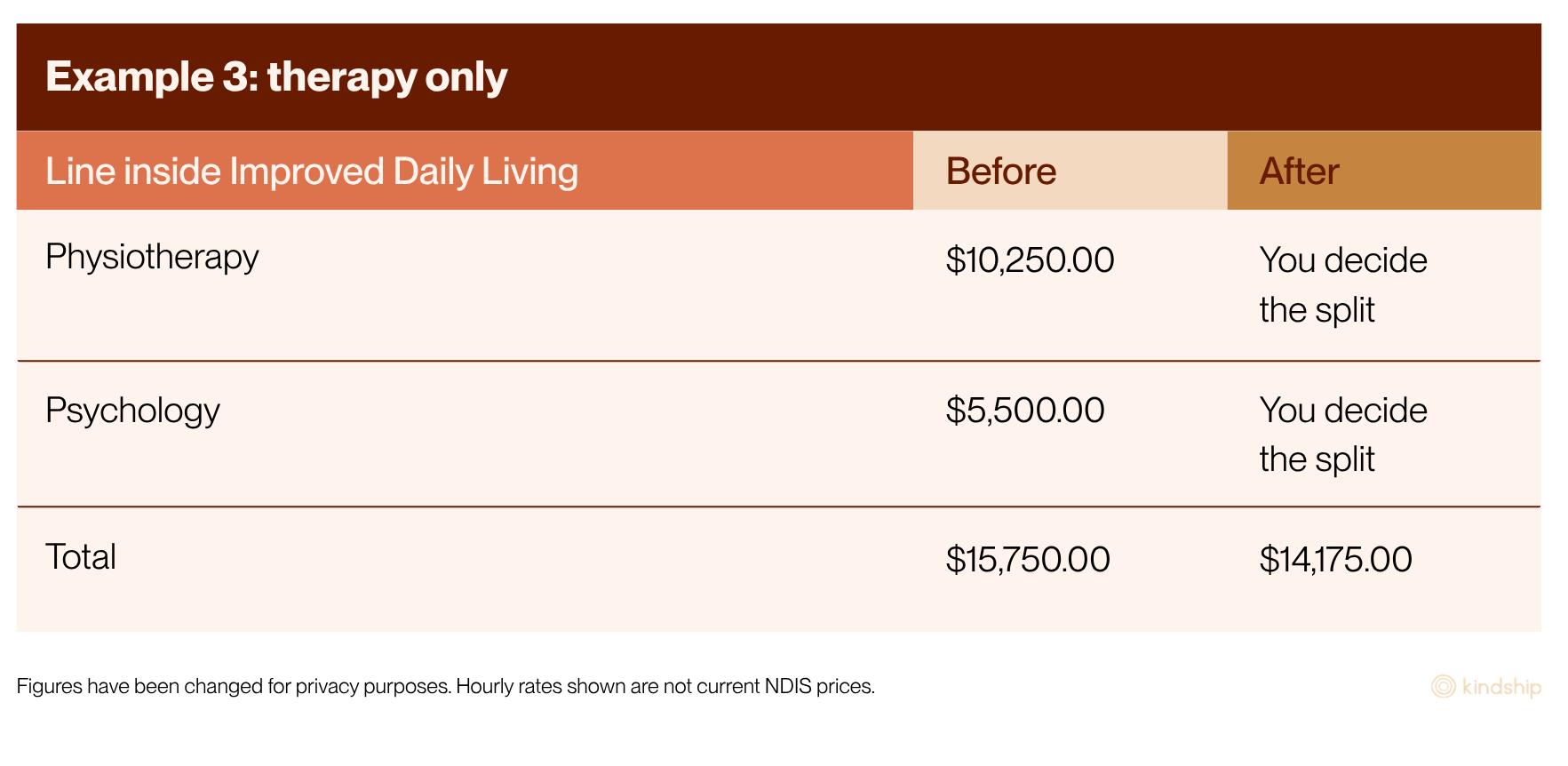
The $1,575 difference is roughly eight hours of therapy at current prices. The reset doesn't tell you which therapist to cut either. You need to work out where the money goes, and where you save it, including enough for the progress reports you'll need before the next reassessment.
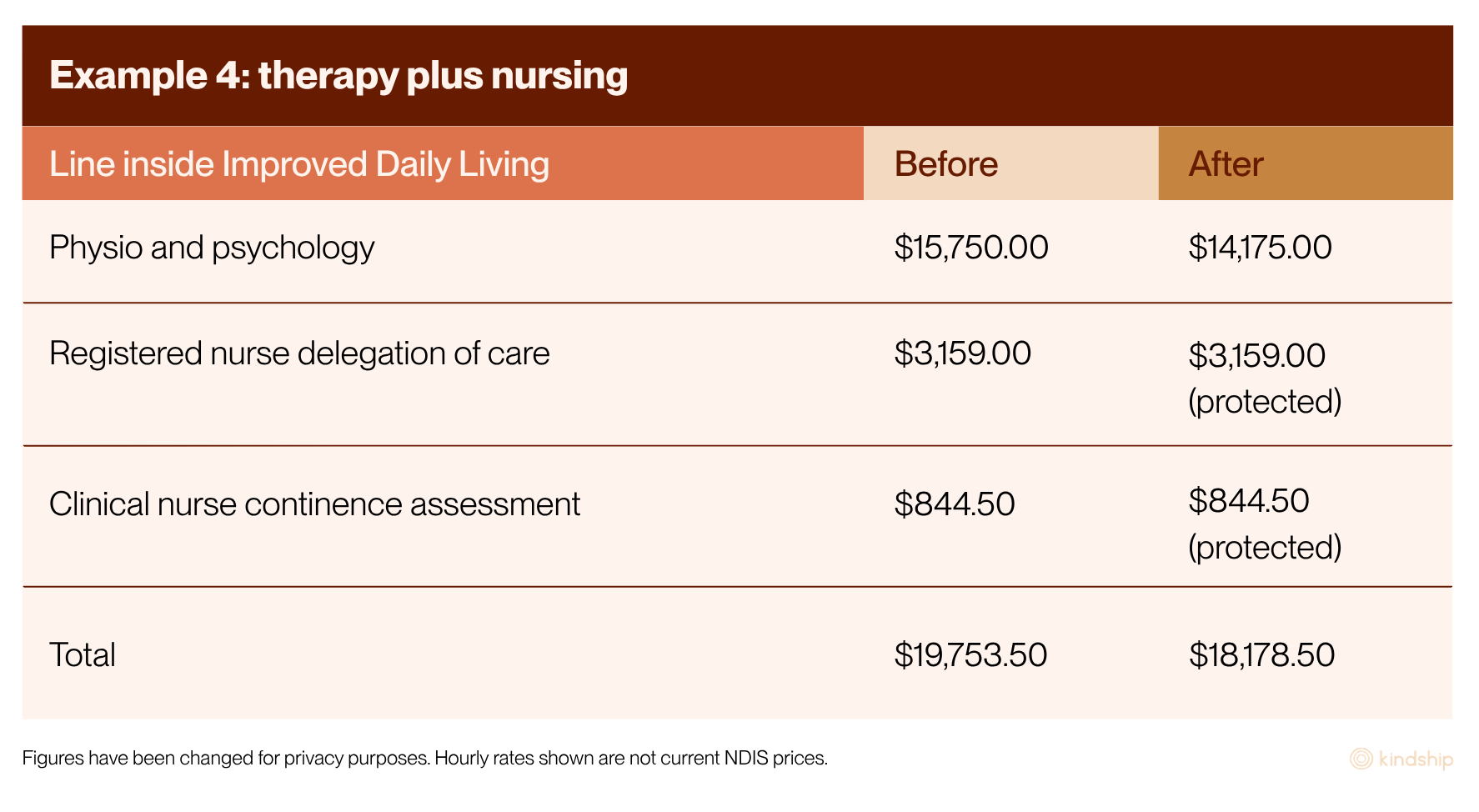
Same therapy, same $1,575 reduction. The nursing sits under disability-related health supports, so it's untouched.
Remember the 2026 claims rule, though. If this plan started before October and is renewed next year, the nursing only stays protected if it was claimed under its nursing line items during 2026.
When will support determinations reach my child's plan?
From 1 October 2026, support determinations apply to brand new plans and any plan that's reassessed. It also applies if your reassessment started before 1 October but your new plan came into effect after it.
From 1 February 2027, plan renewals join the list. That's when the old plan continuations/roll overs disappear and plans renew automatically. The renewal period is for 12 months with the same supports, minus any one-off funding. One of the biggest things to remember is that unspent funds will no longer carry over to the new plan period. And yes, I'm writing February in pencil, not pen. Remember the Agency's record with hitting its own deadlines.
And lastly, by 30 September 2027, every single NDIS plan which has not been renewed/reassessed in the previous 12 months will be renewed, giving them a new start date of 1 October 2027. This doesn't mean everyone gets a full reassessment with a planner. This means you will get the same 12 month's funding reset in your plan as of 1 October 2027, it will also now have support determinations included in the plan.
Can I ask for a review?
No. The reset/support determinations are not a decision about your child, so it isn't a reviewable decision.
What if my child needs support 24 hours a day?
There's a new plan variation pathway for people who qualify as "high support needs". To be eligible, both of these have to be true:
- the combined Assistance with Daily Life, Home and Living, and community participation budgets in the plan are $215,030 or more, counted before the reset
- the plan funds continuous 24-hour care for needs arising directly from the impairment your child access' the NDIS for
The Government used that dollar figure because it's roughly what 24-hour support costs when one worker supports three people, known as a 1:3 ratio.
Only you (child representative), a plan nominee or the participant themself can request initiate a plan variation down this pathway. If you ring the Agency in a panic because your new plan doesn't cover overnight support, the person on the phone cannot trigger this for you. You have 90 days from when the reset occurs and support determinations are added into your child's plan.
If you're eligible and the reset leaves you without enough to keep 24-hour care going, the Agency can put the funding back in your child's plan. The top-up is calculated using the support ratio already funded and can't be more than the amount that was cut, and only goes into Daily Living or Home and Living. It can't go back into the social and community participation budget. So if your child needs one-to-one care, make sure your plan actually funds one-to-one.
If you don't meet the high support needs criteria and you need more funding, the only option you have is to initiate an unscheduled plan reassessments (change of situation) request, speak to your NDIS contact about this.
Is there anything that isn't affected that could help?
Social and Community Participation
There's a Capacity Building budget called Increased Social and Community Participation.
It funds building skills for independence in the community: using public transport, joining in social and recreational activities, and learning everyday tasks. When you think about what a support worker actually does with your child in the community, a lot of it is capacity building. Helping them find the toilet, stay safe near the road, learn the bus route, or scaffold play with other kids so they can do more of it on their own.
Three things to be aware of here
- It's priced at one flat hourly rate with no evening or weekend loading
- You still need to show that it is a reasonable and necessary support for your child. This is also genuinely a capacity building function, not providing personal care tasks whilst in the community.
- If this category is not in your plan, the only way to ask for it is via a plan reassessment. Talk it through with your team first.
Access to Therapy
Ask your GP about a Chronic Condition Management Plan. It gives eligible people up to five Medicare-subsidised allied health visits a year, or ten for Aboriginal and Torres Strait Islander people. It won't replace NDIS therapy, however it is a solid option to help your child continue to work towards their goals with the professionals they need in their life.
What I would actually do right now
- Get your plan breakdown. This shows you how the planner built your child's NDIS budget. Even if your funding is flexible, it will show you what the planner considered as reasonable and necessary when building your plan. This will give you a road map as to what supports and therefore funding in your existing plan are going to be affected by support determinations. Speak to your NDIS contact about this.
- Check how protected supports are being claimed. If your child has nursing, high intensity, behaviour or employment supports funded, make sure providers are invoicing under the right line items before 31 December 2026.
- Find your reassessment date and work out which group you're in in terms of when/how/if support determinations are going to make their way into your child's plan.
- Update your contact details with the NDIA. From 1 October, plans can be suspended if the Agency can't reach you after at least 5 attempts (over 3 months)
FAQs
Does the funding reset apply to self-managed families? Yes. It applies to the plan, regardless how you choose to manage your funding. Self-managed, plan managed or agency managed, the same caps are applied.
Will my child's therapy funding be cut? If the therapy sits in Improved Daily Living, the amount you can use drops by 10% once support determinations are included in your NDIS plan. Nursing, customised and wearable technology and hearing services in those budgets are protected.
My child's reassessment started in September 2026, we don't have the new plan back, will support determinations be applied to their plan? Yes.
Can I appeal the support determination? No, the reset itself isn't reviewable. You can still seek a review of the planner's decisions in your child's plan within three months, and our guide to appealing an NDIS decision walks you through it.
Does the reset apply to new framework plans? No, support determinations only apply to current (old framework) plans. New framework plans are rolling out to participants over the age of 16 from April 2027 (supposedly), and the version for kids hasn't been built yet.
Where to from here
I'm not going to tell you this is fine, because for a lot of families it isn't. You are not imagining that this is hard right now. We are the families carrying this round of reform, however you are also not powerless in it.
If you'd like help working out what the reset means for your child's plan, or you're wondering whether having a plan manager in your corner would make all of this easier to keep track of, we'd love to have a chat. It's free, there's no pressure, and it's just a conversation. Book a call here.
NDIS changes are coming thick and fast right now. If you’d rather hear about them from someone who’s already read the fine print, we’ve got you.
No jargon. No panic. Just the stuff that actually matters for your family.