Parental responsibility. Two words guaranteed to make any parent who's already not feeling all that great about themselves feel like even more of a failure. The kind that leave you asking: if this is all supposed to be on me, why am I finding it so hard?
If you've ever explained your child's day to someone at the NDIA and heard some version of "well, that's just parenting", you know the feeling. The hot face. The deep breath. The urge to hand them your child for 24 hours and see how "just parenting" goes for them.
Because yes, all parents of 7-year-olds do bedtime. Not all parents of 7-year-olds lie beside their child for an hour while they scream and bite themselves, then get up at 1:45am to do it again.
The problem is, that difference lives in your head. You know it. Your partner knows it. Your other kids definitely know it. A planner who has never met your child does not.
That's what an NDIS 24-hour task breakdown is for. It takes everything you do in a day, writes it down hour by hour, and shows the NDIA exactly where ordinary parenting tasks start to blend into disability support.
In my experience, both as a mum and from supporting families through the NDIA system, it's the single most effective way to show the difference between parental responsibility and disability. It's one document that I would not submit a plan reassessment evidence pack without, especially if I am asking for NDIS supports such as in home supports.
In this article, I'll explain what parental responsibility actually means in the NDIS (including what changes in February 2027), how to write a 24-hour task breakdown column by column, and how to use Berry Street Take Two's Child Developmental Milestones guide, a great reference point for what's typical from babies right through to 18, so you're not guessing at what's "typical". I'll also show you real rows from the breakdown I sent for my daughter Pippa's plan reassessment in August 2026.
What is parental responsibility in the NDIS?
Parental responsibility is the care any parent is expected to give a child of the same age, disability or not. The NDIS won't fund that part. It funds the extra.
The NDIS rules (which are like the law) say that when the NDIA looks at a child's plan, it has to consider three things.
- Whether your child's care needs are substantially greater than other children the same age because of their disability.
- Whether caring for your child puts the wellbeing of the people doing it at risk.
- Whether funding a support would build your child's skills or reduce risk.
The NDIA's own reasonable and necessary guideline adds its interpretation on top. It says it's normal for parents to provide substantial care, and usual for parents to provide almost all the care young children need. It also acknowledges that for a child without disability, that care would usually reduce as they get older.
In plain English, this means your child's age is the measuring stick. Bath time for a 2-year-old is parenting. Full hands-on showering for a 12-year-old, every night, through a meltdown, is disability support. The task is the same. The gap is not.
What changes on 1 February 2027
From 1 February 2027, this moves from the rules into section 34 of the NDIS Act itself, as part of the Securing the NDIS for Future Generations reforms.
The Act will say parents are presumed to provide substantial care for their children, and it names what that includes:
- Supervision
- Personal care
- Transport
- Emotional support
- Behavioural support.
Then, and this is the bit that matters, it says that care doesn't include the additional care a child needs because their needs are substantially greater than other children of a similar age because of their disability.
And that's where the power of the 24-hour task breakdown really comes into play. It's you showing the Agency, with evidence, task by task, exactly what that additional care looks like and how much of it there is.
There's a flip side. The NDIA won't be able to fund a support for a child if its main purpose is to reduce the time a parent spends caring below what's reasonably expected, to make the household run more efficiently, or because a parent would rather someone else did the care. So your breakdown needs to keep the focus on your child's needs and safety, not on you needing a babysitter. I'll come back to how.
These changes to how the NDIA decides what's reasonable and necessary for a child (the parental care presumption and the "parent's time" limit above) apply to any decision the NDIA makes from February 2027, including a reassessment of the plan you already have.
If we're being honest, this has always been a bit of an unspoken law. Planners have long measured your child against what's typical for their age, but exactly what counted as "parenting" was never spelled out. From February, it will be, in the Act itself. That's actually good news for families, because it gives you a clear framework to work from, and the 24-hour task breakdown fits it perfectly.
What is a 24-hour task breakdown?
A 24-hour task breakdown is a table that walks a planner through a typical 24 hours of caring for your child, task by task. For every task, it shows what you do, how often you do it, and why that goes beyond what's expected of any parent of a child that age.

Why it works better than anything else
Here's the thing about NDIS evidence. Professional reports tell the NDIA about your child: their diagnosis, their functional capacity, what their therapists recommend. They're essential. However, very few of them describe what actually happens in your house at 1:45am, or how long it takes to get one small person dressed, fed through a tube and out the door.
The 24-hour breakdown fills that gap. It does three jobs at once.
- It makes the invisible visible. So much of what we do never makes it into a report. Sterilising feeding equipment after every feed. Keeping a stock of one specific brand of crackers because nothing else will be eaten. The planning that happens in your head before you can even leave the house.
- It speaks the NDIA's language. The test is literally whether your child's needs are substantially greater than other children the same age. A breakdown answers that question directly, row by row, instead of leaving the planner to work it out.
- It makes everything else make sense. When a planner can see you're providing full personal care several times a day, the request for support workers or continence supports stops looking like a wish list. Its a reflection of what is actually happening.
It's also the document every other piece of your evidence hangs off. Your carer statement shows what the gaps cost your family. Your supports table shows what you're asking for to fill them. The breakdown is where you show the gaps exist in the first place.
How to write a 24-hour task breakdown, column by column
You need four columns. The first three are easy. The fourth is where most families sell themselves short.
Time. When it happens. Be specific. "6:30am" tells a story that "morning" doesn't, and "1:45am to 2:30am" tells a much bigger one.
What I do. What you physically do, in first person. This is the most important habit to get into: write what you do, not what your child can't do. "She struggles with dressing" tells a planner nothing. "I fully dress her, twice a day" tells them exactly what the support is.
How often. Daily, nightly, six times a day, several nights a week. Frequency turns a hard moment into a pattern, and a pattern is what a planner is looking for.
Why this goes beyond typical parenting for a child this age. This is the column that does the heavy lifting, and the one families most often leave blank, because to us it's obvious. It needs three things: what most children your child's age can do, what you do instead, and what it costs (your sleep, your other children, someone's safety).
How to work out what's "typical" without guessing
This is where a lot of parents get stuck. How are you meant to know when most kids stop needing help to brush their teeth? You've been in survival mode for years.
This is a great guide from Merry Street's Take Two Program Child Developmental Milestones: Foundations for Practice. It's free, it's Australian, and unlike most milestone guides it runs all the way from babies to 18, broken into cognitive, speech and language, social, emotional, physical and sleep domains.
A few everyday milestones from it, in my own words:
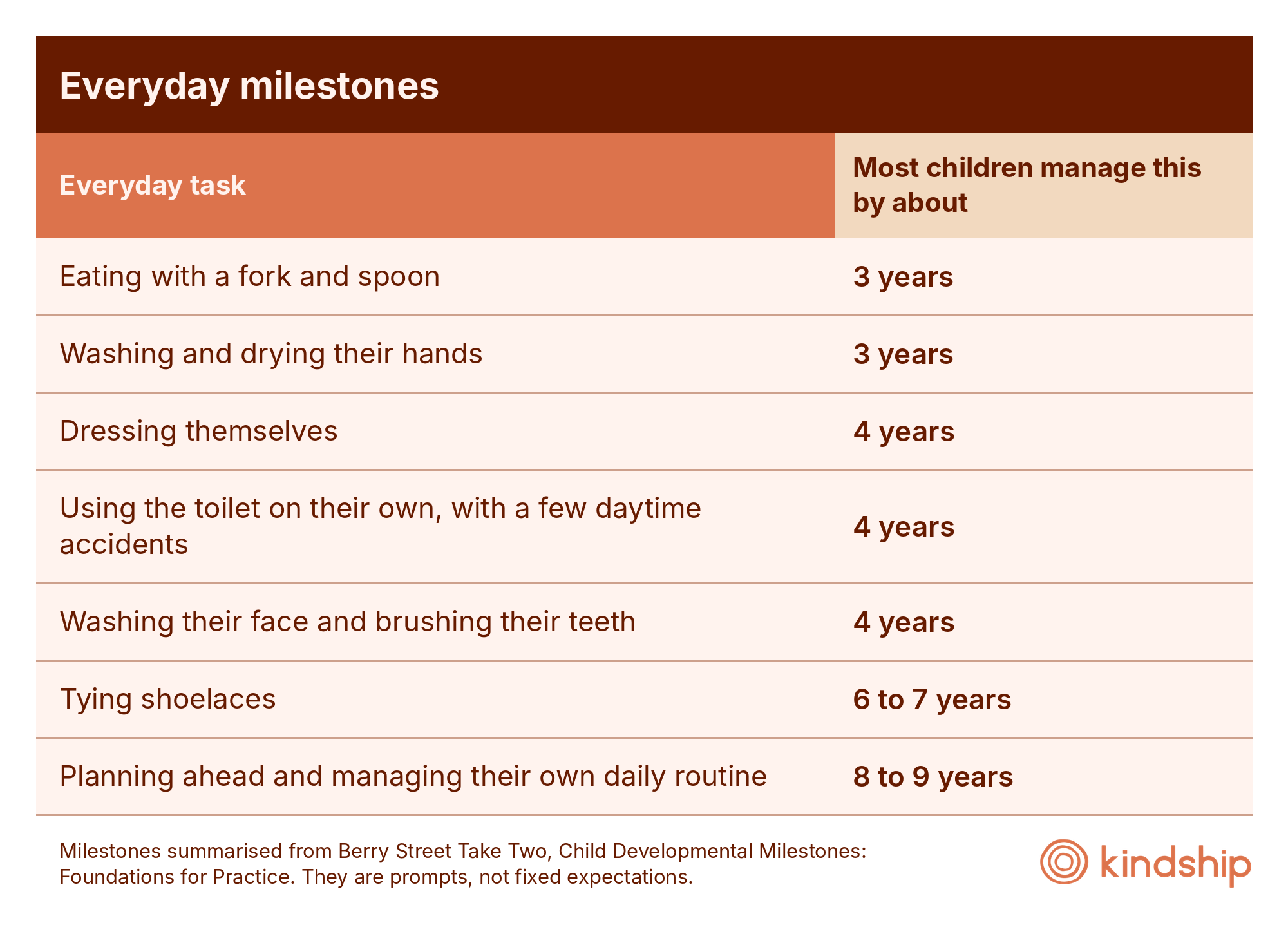
So instead of "most kids can dress themselves", you can write "most children dress themselves by approx 4 years old. My daughter is 7 and needs full hands-on help, twice a day." That gap speaks for itself. Make sure you reference the Child Development Milestones so they can see you are getting the milestone information from a credible source.
Two honest notes. The guide itself says its milestones are prompts, not fixed expectations, and every child develops at their own pace. Use it to show a clear gap, not to argue over a few months. And be honest about what's still typical. The guide says night-time wetting and wanting to climb into a parent's bed after a nightmare are common at 3 to 5 years.
Don't forget the invisible stuff
Go back your day and look for the care that doesn't look like care: preparing a separate meal, packing medical equipment, cleaning and sterilising, managing meds, organising appointments, extra laundry, and the hours of supervision that mean you can't leave the room. If your child needs it because of their disability, and a child their age wouldn't, it goes in.
If every day looks different, write a typical day and say how often the harder version happens ("three or four nights a week"). Appointments, hospital visits and school meetings that don't happen daily can go in a separate section at the end.
A real 24-hour task breakdown: my own
My daughter Pippa lives with Weidemann-Steiner Syndrome, for her it looks like an intellectual disability, feeding challenges and she's not as physically able as other kids her age. She was 7 when I wrote this. These rows are straight from the breakdown I sent for her plan reassessment.
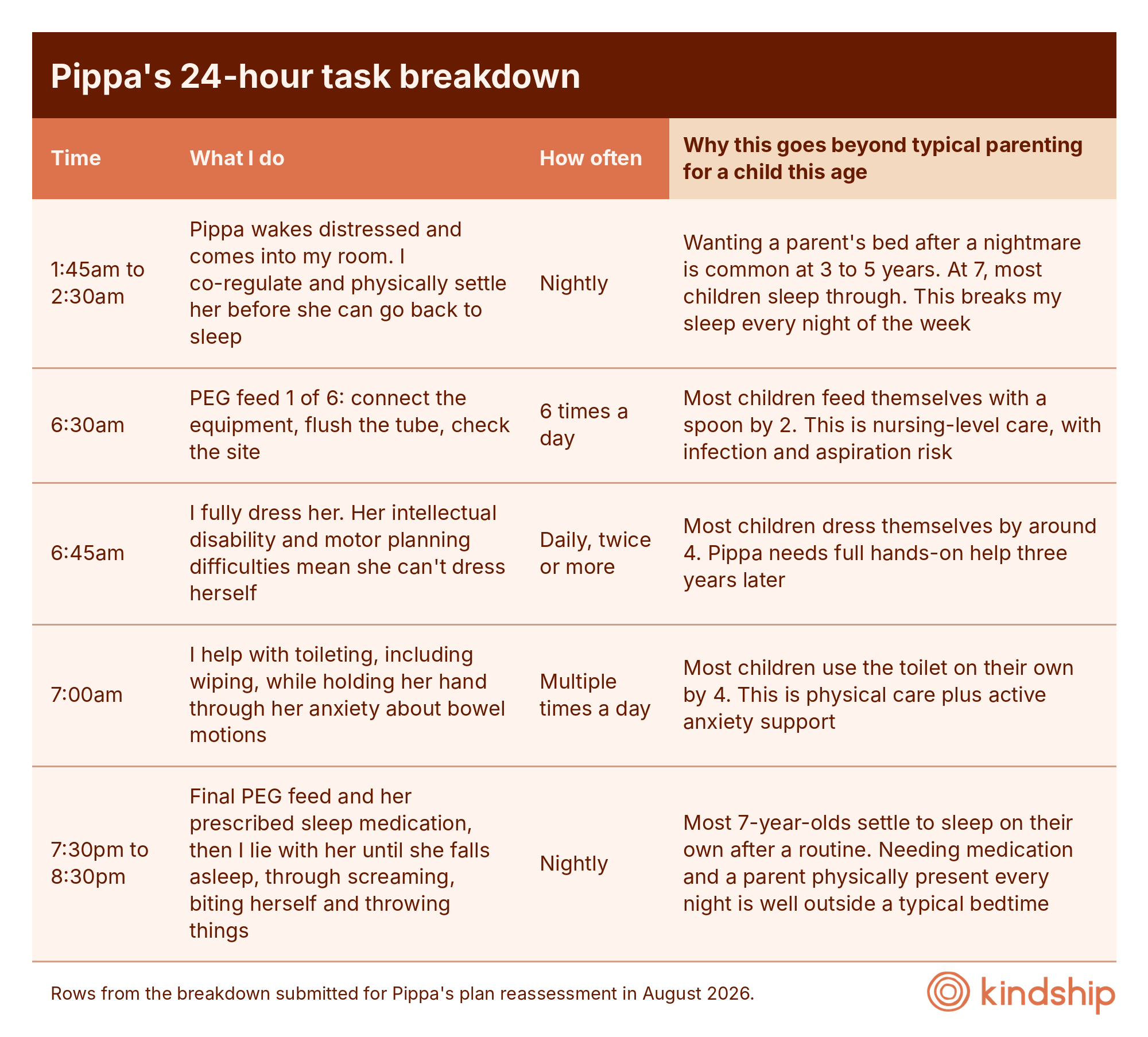
Notice a few things. The night row comes first. Every row says what I do, not what Pippa can't do. Every row has a frequency. And every "why" sentence names what's typical, then the gap.
My full breakdown also covered washing and sterilising feeding equipment after every one of her six feeds, continuous one-to-one supervision for behaviours that put her and others at risk, full help in the shower, and changing wet bedding several nights a week despite an overnight nappy. None of it is typical parenting of a 7-year-old. If I hadn't written it down, it wouldn't have existed as far as the NDIA was concerned.
The mistakes families make
I've read a lot of these over the years, mine included. These are the ones that come up again and again.
Describing your child instead of your care. "He has poor fine motor skills" belongs in the OT report. Your breakdown is about what you do because of it.
A blank or vague last column. "It's really hard" is true, but it doesn't answer the question the NDIA is asking. Name what's typical for their age, then the gap.
Writing your worst day as if it's every day. It's tempting, especially when you've been told no before. It also makes everything else in the document easier to doubt. Write a typical day and say how often the harder version happens.
Making it about needing a break. Your exhaustion is real and it matters. From 1 February 2027, though, the NDIA can't fund a support for a child if its main purpose is to give parents time back. Keep the focus on what you do to meet your child's needs, and what happens to their safety or anyone else's when that need isn't met.
A breakdown that doesn't match the rest of your evidence. If your OT's report says your child dresses with prompting and your breakdown says full hands-on help, the planner has to pick one, and it won't be yours. Everything you send needs to tell the same story.
Leaving out the boring bits. Sterilising, laundry, packing medical gear, chasing scripts. It doesn't feel like "care". It is, and it adds up.
What about teenagers and adult children?
The same idea works for teenagers, with one adjustment. The Take Two guide runs to 18, but for teens it focuses more on thinking, language and puberty than on everyday independence like cooking a meal, catching a bus or managing medication. For those, compare against what most young people their age do with little or no help, and ask your child's OT whether their assessment gives age equivalents.
For adults, the question changes. The presumption that parents provide substantial care only applies to children. For a participant over 18, the NDIA looks at whether relying on family puts anyone at risk, whether it's suitable for family to provide the support (think about the carer's age and health, how intense the support is, and whether it's age and gender appropriate), and whether the arrangement is sustainable long term.
So for an adult child, the last column becomes: why isn't it reasonable or sustainable for family to keep providing this? A 70-year-old dad lifting his 30-year-old son says more than any milestone chart ever could.
How to fill it out
- Track a real week first. Before you write anything formal, jot down times on your phone as they happen, especially overnight. You'll be surprised what you've stopped noticing.
- Write nights first, then a typical day. Use the four columns, and write in first person about what you do.
- Fill in the last column using the Take Two guide. One sentence on what's typical for their age, one on what you do instead, and what it costs.
- Check it against your professional reports. Sit it next to your functional capacity assessment or OT report. If they describe your child differently, talk to your OT before anything goes to the NDIA.
- Ask for age equivalents if your child is older. Speak to your child's OT about whether their assessment can give them.
- Use it to work out what you're asking for. Circle the rows with the biggest gaps. That's where your supports go, and it's how your supports table, reports and breakdown end up telling the same story.
- Date it, name it, keep a copy. If you're asking for a plan reassessment yourself, the NDIA's guideline says evidence should be from the last four months and dated after your current plan was approved. Speak to your NDIS contact about timing.
FAQs
Every day with my child is different. How do I write a 24-hour task breakdown for the NDIS?
Write a typical day, then note how often the harder version happens, for example "three or four nights a week she wakes and needs an hour of settling". The planner needs the pattern, not every exception.
Will the NDIA actually read a breakdown I wrote myself, or does it need to come from a professional?
You write it. It's your lived experience, and nobody else can describe your nights. It sits alongside your professional reports, not instead of them, which is why it needs to match what they say.
My child is 3. Isn't almost everything "parental responsibility" at that age?
A lot more is, yes. The NDIA's guideline says it's usual for parents to provide almost all the care young children need. The gap can still be big, though. A 3-year-old fed through a tube six times a day, or needing to be lifted in and out of bed, is well outside typical care at any age.
What evidence should I include for an NDIS plan review? Y
our professional reports, your 24-hour task breakdown, a carer statement, and a table of the supports you're asking for, all telling the same story.
Is a 24-hour task breakdown the same as the new 24-hour care pathway?
No. The High Support Needs pathways is a variation process for people who are already funded for round-the-clock support and are put at risk as a result of their supports being cut by Support Determinations. A 24-hour task breakdown is evidence any family can write.
Can I mention my other children in it?
Yes, briefly. Siblings make a useful same-household comparison ("her sisters, aged 10 and 11, do this independently"). If a sibling's own health affects your capacity to care, that usually belongs in your carer statement, and only with their permission.
What if the NDIA still says it's parental responsibility?
You can ask for an internal review of the decision. Our blog on how to appeal an NDIS decision walks you through it step by step.
Where to from here
Writing down everything you do in a day can be confronting. Seeing it all in one table, maybe for the first time, can hit hard. If that's where you are right now, be gentle with yourself. It's a lot.
If you'd like our free 24-hour task breakdown template, you can download it here. And if you'd like a hand pulling your evidence together, or you want a plan manager who actually gets it because we live it too, we'd love to chat. Book a call here.